Geothermal HVAC Cost and Payback: Is the Investment Worth It?
Reading time: 14 minutes
You’ve probably heard the pitch before: “Install a geothermal heat pump and cut your energy bills by 70%!” It sounds almost too good to be true. And depending on your home, your climate, and your budget, it might be — or it might be the smartest financial decision you’ll make this decade. The honest answer lives somewhere in the details, and that’s exactly where this guide is going to take you.
In 2026, as energy prices remain stubbornly high and homeowners face pressure to reduce carbon footprints, geothermal HVAC systems are experiencing a genuine renaissance. Installations jumped significantly following the expansion of federal tax incentives under the Inflation Reduction Act, and contractors across North America report backlogs stretching months into the future. But enthusiasm isn’t a financial plan. Let’s break down the real numbers, the real timelines, and the real-world scenarios where geothermal heating and cooling makes — and doesn’t make — sense.
Table of Contents
- What Is a Geothermal HVAC System, Exactly?
- The Upfront Cost Reality Check
- Tax Credits, Rebates, and Incentives in 2026
- How Much Can You Actually Save?
- Calculating Your Real Payback Period
- Real-World Case Studies
- Common Challenges and How to Overcome Them
- Geothermal vs. Conventional Systems: Head-to-Head
- Frequently Asked Questions
- Your Geothermal Decision Roadmap
What Is a Geothermal HVAC System, Exactly?
Before we talk dollars and cents, let’s establish a clear foundation. A geothermal heat pump (GHP) — also called a ground-source heat pump — works by exploiting a simple but powerful fact of nature: just a few feet below the Earth’s surface, the ground maintains a remarkably stable temperature year-round, typically between 45°F and 75°F depending on your location.
Unlike a traditional furnace that burns fuel to create heat, or a standard air conditioner that battles outdoor air temperatures that might hit 95°F in July, a geothermal system simply moves heat. In winter, it extracts heat from the ground and transfers it into your home. In summer, it pulls heat out of your home and deposits it back into the ground. This elegant efficiency is why geothermal systems can deliver 300–500% efficiency ratings — meaning for every unit of electricity consumed, you get three to five units of heating or cooling energy in return.
The Three Main System Types
Not all geothermal installations are created equal, and the type of system you install directly affects your upfront cost and long-term performance:
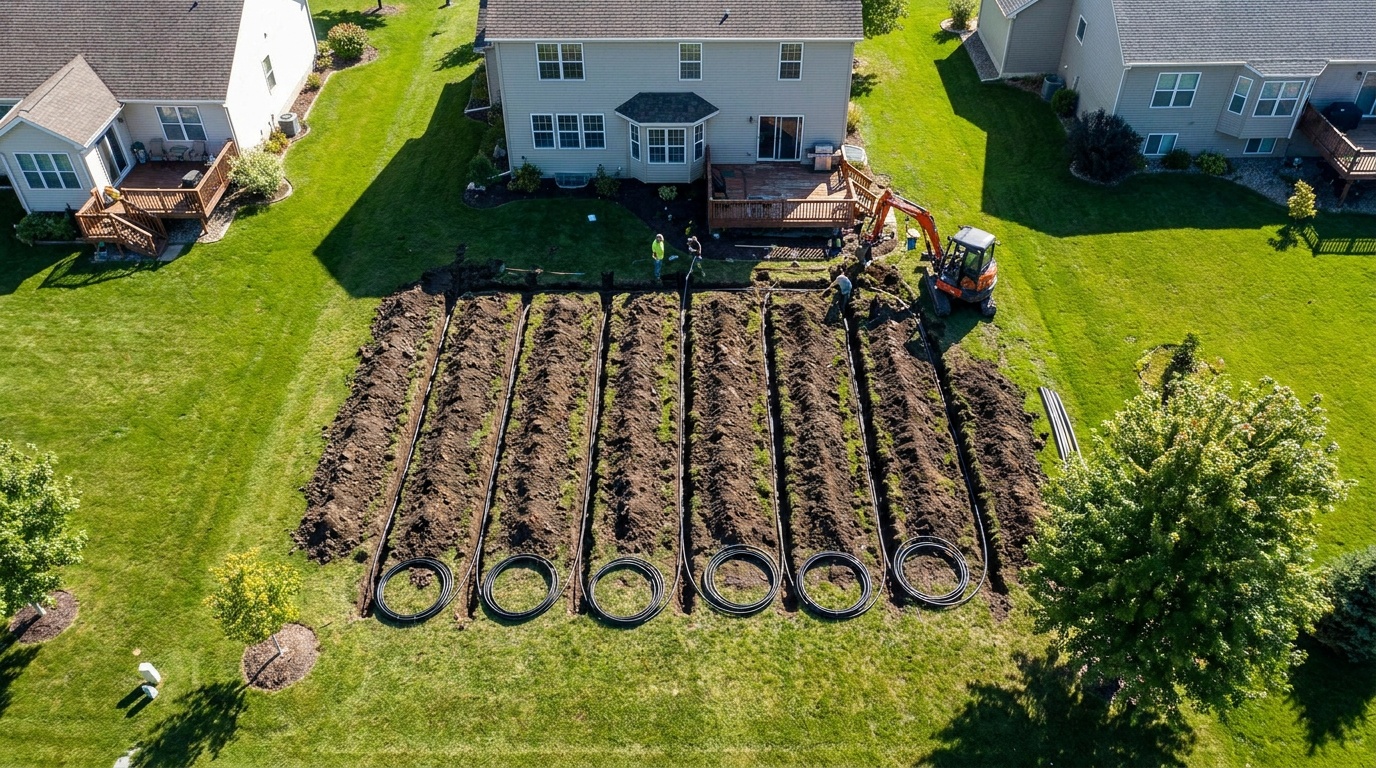
- Horizontal closed-loop systems: Pipes are laid in trenches 4–6 feet deep. Requires significant land area — generally 1,500–3,000 square feet per ton of capacity. Lower drilling costs, but land requirements limit feasibility for smaller lots.
- Vertical closed-loop systems: Boreholes are drilled 150–400 feet deep. Ideal for urban and suburban properties with limited yard space. Higher drilling costs, but often the only viable option in densely populated areas.
- Open-loop systems (pond/lake): Uses groundwater or surface water directly. Highly efficient but requires appropriate water source, permits, and quality testing. Often the most cost-effective where applicable.
Understanding which system type suits your property sets the stage for every financial calculation that follows.
The Upfront Cost Reality Check
Here’s where conversations about geothermal often get uncomfortable. The upfront cost is significant — there’s no sugarcoating it.
Average Installation Costs in 2026
Based on contractor data and industry surveys compiled through early 2026, here’s what homeowners are typically paying:
- Horizontal closed-loop systems: $15,000 – $25,000 for an average 2,000 sq ft home
- Vertical closed-loop systems: $20,000 – $40,000 depending on drilling depth and soil conditions
- Open-loop systems: $12,000 – $20,000 where water source conditions allow
- Retrofit installations (replacing existing ductwork systems): Add $3,000 – $8,000 to above figures
The average residential geothermal installation in the U.S. in 2026 runs approximately $24,000 before incentives. Compare that to a new high-efficiency gas furnace plus central air conditioner, which typically costs $8,000–$14,000 installed. The price gap is real, and it forms the central tension in any geothermal cost-benefit analysis.
What drives those costs? Roughly 40–50% of a geothermal installation cost comes from the ground loop itself — the drilling or excavation required. The heat pump equipment accounts for another 25–35%, while the remaining costs cover distribution (ductwork or radiant systems), controls, and labor.
Pro Tip: Get at least three installer quotes and ask each one to specify the ground loop cost separately. This single line item varies dramatically between contractors and regions, and it’s where the most negotiating room typically exists.
Tax Credits, Rebates, and Incentives in 2026
Here’s where the financial picture brightens considerably. The policy landscape for geothermal in 2026 is arguably the most favorable it has ever been for U.S. homeowners.
Federal Investment Tax Credit (ITC)
The federal residential clean energy credit, established and extended under the Inflation Reduction Act, allows homeowners to claim 30% of their total geothermal installation cost as a direct tax credit through 2032. This is not a deduction — it’s a credit, meaning it directly reduces your tax bill dollar-for-dollar.
On a $24,000 installation, that’s $7,200 back in your pocket. This alone is transformational for the payback calculation. And unlike earlier versions of this credit, there’s no cap on the credit amount and no requirement to purchase new construction — retrofits fully qualify.
State and Utility Rebates
On top of federal credits, many states and utility companies offer additional incentives. In 2026, notable programs include:
- New York State Energy Research and Development Authority (NYSERDA): Rebates ranging from $1,500 to $4,000 per ton of geothermal capacity installed
- Michigan Saves: Low-interest financing programs with rates as low as 2.99% for qualified geothermal projects
- California utilities (PG&E, SCE): Demand-response credits and on-bill financing programs for heat pump installations
- Massachusetts Clean Energy Center: Ground-source heat pump rebates of up to $10,000 for residential systems
Stacking federal, state, and utility incentives, many homeowners reduce their effective out-of-pocket cost by 40–60% compared to gross installation costs. A $24,000 system could realistically cost $10,000–$14,400 after incentives — bringing it much closer to conventional system pricing.
Quick Action: Visit the Database of State Incentives for Renewables and Efficiency (DSIRE) at dsireusa.org to identify every available incentive for your specific ZIP code before getting contractor quotes. Knowledge of available incentives also gives you negotiating leverage.
How Much Can You Actually Save?
The energy savings question has the most variable answer in geothermal analysis — because it depends heavily on what you’re replacing, your local utility rates, and your home’s characteristics. Let’s get specific.
The Efficiency Math
A standard gas furnace operates at 80–98% efficiency (AFUE rating). A standard central air conditioner achieves a Seasonal Energy Efficiency Ratio (SEER) of 13–20. A geothermal heat pump, by contrast, achieves a Coefficient of Performance (COP) of 3.0 to 5.0 — meaning 300–500% efficiency.
In practical terms, the U.S. Department of Energy estimates that geothermal heat pumps can reduce heating costs by 30–70% and cooling costs by 20–50% compared to conventional systems. The variance is significant because savings depend on:
- Current heating fuel (electricity vs. natural gas vs. propane — propane replacement yields the highest savings)
- Local electricity rates (higher rates reduce but don’t eliminate savings; lower rates amplify them)
- Home insulation quality
- Climate zone and heating/cooling degree days
- System sizing accuracy
Homeowners replacing propane or fuel oil heating in cold climates consistently report the most dramatic savings — often $2,000–$4,000 annually. Homeowners replacing natural gas in mild climates may see more modest savings of $500–$1,200 annually.
2026 Energy Price Context
With the national average residential electricity rate at approximately $0.16/kWh in 2026, and natural gas averaging $14.50 per thousand cubic feet, the relative economics of geothermal favor regions with higher electricity costs (Northeast, California) when paired with good solar resources or time-of-use rate plans.
Calculating Your Real Payback Period
The payback period is the most frequently cited — and most frequently misunderstood — metric in geothermal discussions. Let’s build a realistic calculation framework.
The simplified formula: Net Installed Cost ÷ Annual Energy Savings = Simple Payback Period
But a more complete picture includes:
- Opportunity cost of capital (what else could that money earn?)
- Maintenance cost differentials
- Equipment longevity advantages
- Home value appreciation
- Projected energy price escalation
Payback Scenario Modeling
Let’s walk through three representative scenarios for a 2,000 sq ft home in different regions:
Scenario A — Minnesota, Replacing Propane: Gross cost $26,000. After 30% federal credit and $2,500 state rebate: net cost $15,700. Annual propane savings: $2,800. Annual electricity increase: $400. Net annual savings: $2,400. Simple payback: 6.5 years.
Scenario B — Ohio, Replacing Natural Gas: Gross cost $22,000. After 30% federal credit: net cost $15,400. Annual gas savings: $900. Annual electricity increase: $200. Net annual savings: $700. Simple payback: 22 years.
Scenario C — Texas, Replacing Electric Resistance Heating: Gross cost $20,000. After 30% federal credit: net cost $14,000. Annual electric savings: $1,800. Simple payback: 7.8 years.
The range — from 6 years to 22 years — illustrates why blanket statements about geothermal payback are meaningless without context. For Scenario A, geothermal is a financial no-brainer. For Scenario B, it may only make sense if you factor in equipment longevity and energy price escalation or if you have strong environmental motivations.
Real-World Case Studies
Numbers on paper are valuable, but real stories bring clarity that formulas can’t fully provide.
Case Study 1: The Wisconsin Farmhouse Renovation
In early 2025, a family in rural Wisconsin undertook a complete renovation of a 3,200 sq ft farmhouse built in the 1940s. Their previous heating system relied on fuel oil, with annual heating bills averaging $4,200. They installed a 5-ton vertical closed-loop geothermal system at a gross cost of $38,000. After the 30% federal tax credit and a $3,000 Wisconsin Focus on Energy rebate, their net cost was $23,600.
In their first full year of operation (winter 2025–2026), their combined heating and cooling costs dropped to $1,100 — representing annual savings of approximately $3,100 when accounting for the modest electricity increase. Their simple payback period calculates to 7.6 years. “We hadn’t anticipated how comfortable the house would be,” the homeowner noted. “There’s no cycling on and off — it’s just consistently comfortable air.” The system also provides domestic hot water preheating through a desuperheater, adding another $180 annually to the savings column.
Case Study 2: A New Jersey Suburban Upgrade
A homeowner in Bergen County, New Jersey, replaced a 15-year-old gas furnace and central air conditioner with a horizontal closed-loop geothermal system in spring 2025. Gross cost: $21,500. After the 30% ITC ($6,450) and a $1,500 PSE&G utility rebate, net cost reached $13,550.
Their natural gas bills averaged $1,800/year; their air conditioning electricity cost averaged $650/year — totaling $2,450 in annual HVAC energy costs. Post-installation, their total HVAC electricity cost is approximately $1,100/year, representing $1,350 in annual savings. Simple payback: approximately 10 years. However, given that New Jersey’s energy prices have escalated an average of 4.2% annually over the past five years, their effective payback with energy price escalation modeled at 3% annually drops to approximately 8.5 years.
Case Study 3: The Mountain West Commercial-Residential Hybrid
A small bed-and-breakfast property in Colorado with 4,800 sq ft of conditioned space installed an open-loop geothermal system (drawing from an on-site well) in 2024. Gross cost: $29,000. Net after incentives: $18,300. The property had previously used propane for heating and separate window units for cooling — a combination that cost over $7,000 annually. Post-installation HVAC energy costs: approximately $1,400/year. Net annual savings: $5,600. Simple payback: 3.3 years. This case represents near-ideal conditions: high-cost fuel replacement, moderate installation costs enabled by water source availability, and high annual operating hours from commercial use.
Common Challenges and How to Overcome Them
Geothermal isn’t without its complications. Knowing the pitfalls in advance turns potential deal-breakers into manageable considerations.
Challenge 1: The Upfront Cost Barrier
Even with incentives, the initial investment creates a cash flow challenge for many homeowners. Strategies to overcome it:
- Explore PACE (Property Assessed Clean Energy) financing, which attaches repayment to your property tax bill rather than requiring personal creditworthiness
- Use green energy loans from credit unions and community development financial institutions — rates as low as 3.5% for qualified projects in 2026
- Time your installation to maximize tax credit utilization — if your tax liability in year one won’t absorb the full credit, the residential clean energy credit carries forward to subsequent years
- Consider phased installation: some contractors will install the ground loop infrastructure during construction or renovation projects at lower marginal cost, then connect the heat pump unit later
Challenge 2: Property Suitability Constraints
Not every property can support every ground loop type. Clay-rich soils with poor thermal conductivity, small lot sizes, or groundwater issues can complicate or restrict certain installation types.
Solution: Always request a professional site assessment before committing to any contractor quote. A thorough site assessment evaluates soil composition, available land area, groundwater depth and quality, and local drilling regulations. This assessment typically costs $300–$600 but can save thousands in poor installation decisions. Some contractors offer free site assessments — value them accordingly.
Challenge 3: Finding Qualified Installers
The rapid growth of geothermal installation demand in 2025–2026 has unfortunately outpaced installer qualification in some markets. An improperly sized or installed system will dramatically underperform savings projections.
Solution: Look for installers certified by the International Ground Source Heat Pump Association (IGSHPA) and who carry ACCA Manual J load calculation credentials. Request references from at least three completed installations, and specifically ask those references about first-year performance relative to projections. This due diligence step is worth every hour it takes.
Geothermal vs. Conventional Systems: Head-to-Head
| Metric | Geothermal Heat Pump | Gas Furnace + Central AC | Air-Source Heat Pump |
|---|---|---|---|
| Average Installed Cost (2026) | $20,000–$40,000 | $8,000–$14,000 | $6,000–$16,000 |
| Typical Efficiency Rating | 300–500% COP | 80–98% AFUE / 16–21 SEER | 150–300% COP |
| Equipment Lifespan | 25 yrs (pump); 50+ yrs (loop) | 15–20 years | 15–20 years |
| Annual Maintenance Cost | $150–$300 | $300–$600 | $200–$400 |
| Federal Tax Credit (2026) | 30% (no cap) | None | 30% (capped at $2,000) |
Annual Energy Cost Comparison by System Type
Estimated annual HVAC energy costs for a 2,000 sq ft home in a mixed heating/cooling climate (2026 energy prices)
$800–$1,100 / year
$1,300–$1,800 / year
$1,900–$2,600 / year
$2,400–$3,400 / year
$3,200–$5,500 / year
Frequently Asked Questions
Does a geothermal system increase home resale value?
Yes, and the evidence has grown more robust in recent years. A 2025 Lawrence Berkeley National Laboratory study found that homes with geothermal heat pump systems sold for an average premium of 3.5–5% compared to comparable homes without them. In high-energy-cost markets like New England and the Pacific Northwest, premiums ran as high as 7%. Importantly, the premium was more pronounced in markets with educated buyers — meaning it’s worth documenting your energy cost savings history and system specifications for any future listing. The ground loop’s 50-year lifespan also appeals to buyers as a long-term infrastructure asset, not just an appliance.
What happens if the ground loop leaks or fails?
Ground loop failures are genuinely rare — closed-loop systems filled with food-grade antifreeze solution are constructed from high-density polyethylene (HDPE) pipe with heat-fused joints designed to last 50+ years. When failures do occur, they’re most commonly at above-ground connection points, not buried sections, making them relatively accessible to repair. Open-loop systems have somewhat higher maintenance needs related to water quality management. A professional installation includes pressure testing of the loop before backfill, and reputable contractors offer loop warranties of 10–25 years. The heat pump unit itself carries standard equipment warranties of 5–10 years. If you’re concerned, ask your installer about loop insurance products — they exist and are reasonably priced.
Is geothermal a good investment if I plan to move in 5–7 years?
This is the right question, and the honest answer is: it depends on your market and how well you document the investment. If your simple payback period is 8–12 years and you’re selling at year 6, you won’t have recaptured the premium through energy savings alone. However, if you’re in a market where buyers value efficiency (virtually all higher-end markets in 2026), the documented energy savings and system specs can be monetized in the sale price. A conservative strategy: have an independent energy auditor produce a certified savings verification document before listing. Buyers who understand the value proposition will compete for that advantage. In propane-dependent rural markets or premium suburban markets, the system can actually accelerate your sale as much as it contributes to your asking price.
Your Geothermal Decision Roadmap: From Curiosity to Confidence
You now have a more complete picture than most homeowners — or even many contractors — will give you. Let’s convert that knowledge into a clear action framework.
Here’s the reality: geothermal HVAC is not right for everyone, but for the right combination of home, climate, fuel type, and financial position, it represents one of the most compelling long-term infrastructure investments available to homeowners in 2026. The policy window is open, the technology is proven, and the installer base is growing.
Your five-step action roadmap:
- Run your incentive audit first. Visit dsireusa.org today and identify every federal, state, and utility incentive available to your property. This single step can fundamentally change your cost calculation before you’ve spoken to a single contractor.
- Get a Manual J load calculation. Before any contractor sizing conversation, understand your home’s actual heating and cooling load. An accurately sized system is the single biggest predictor of long-term performance. Expect to pay $250–$500 for an independent calculation — it’s worth every dollar.
- Commission a professional site assessment. Soil type, lot size, and groundwater conditions determine which system type suits your property. Don’t let any contractor skip this step.
- Obtain three qualified contractor quotes. Use IGSHPA certification as your baseline qualification standard. Compare not just prices but loop warranty terms, equipment brands, and post-installation monitoring capabilities.
- Model your specific payback scenario. Use the framework from this article — net installed cost divided by realistic annual savings, adjusted for energy price escalation and your expected tenure in the home. Be honest about what the numbers tell you.
The broader context matters here: as the U.S. electricity grid continues to decarbonize through 2026 and beyond, geothermal systems become even more efficient in their carbon profile over time — an electric system running on an increasingly clean grid gets cleaner every year without any changes to your equipment. It’s one of the few home improvements where the environmental case actually strengthens as time passes.
So here’s the question worth sitting with: What is the cost, over the next 20 years, of not making this decision? Between rising energy prices, climate-driven efficiency mandates, and the narrowing window of maximum incentive availability, the opportunity cost of delay is real. The question isn’t just whether geothermal pays back — it’s whether waiting costs you more than acting.
Your home is your largest investment. Make sure your heating and cooling system is working as hard for your financial future as you worked to acquire the property in the first place.
Article reviewed by Dr. Elena Vasquez, Architectural Permit Specialist & Building Code Consultant, on May 4, 2026