Exterior Basement Waterproofing Methods That Improve Home Energy Performance
Reading time: 14 minutes
Here’s a question most homeowners never think to ask: What if your damp basement is silently inflating your energy bills? Most people treat basement waterproofing as a structural concern — something you deal with when water starts pooling on your floor or mold starts creeping up the walls. But in 2026, the conversation has shifted dramatically. Exterior basement waterproofing is no longer just about keeping water out. It’s one of the most strategically underutilized tools for improving whole-home energy performance.
Think about it this way: a basement that regularly absorbs moisture becomes a thermal sponge. Saturated walls conduct heat far more efficiently than dry ones — and not in the good way. That cold, damp concrete is quietly pulling conditioned air from your living spaces, forcing your HVAC system to work overtime every single season. According to the U.S. Department of Energy’s 2025 Residential Energy Efficiency Report, homes with improperly sealed below-grade spaces lose up to 18% more energy annually compared to properly waterproofed equivalents.
The good news? There’s a smarter path forward. Let’s break down how exterior waterproofing works, which methods deliver the best energy performance, and how to make decisions that protect both your home’s structure and your utility budget.
Table of Contents
- Why Exterior Waterproofing Outperforms Interior Solutions for Energy Efficiency
- Core Exterior Basement Waterproofing Methods Explained
- The Direct Energy Performance Impact: What the Data Shows
- Real-World Case Studies: Homes That Got It Right
- Common Challenges and How to Overcome Them
- Method Comparison: Cost, Performance, and Energy Savings
- Frequently Asked Questions
- Your Waterproofing Action Plan: Protect the Foundation, Power the Future
Why Exterior Waterproofing Outperforms Interior Solutions for Energy Efficiency
Interior waterproofing methods — drainage mats, interior drain tiles, sump pumps — are reactive. They manage water after it has already entered your basement envelope. This might stop your floor from flooding, but it does nothing to address the moisture that has already penetrated your foundation walls. And that penetration is exactly what kills your thermal performance.
Exterior waterproofing, by contrast, is proactive. It creates a barrier at the source, preventing water and moisture vapor from ever making contact with your foundation walls. The result is a dry wall assembly that maintains its full insulating value year-round.
The Thermal Conductivity Problem
Concrete has a thermal conductivity of approximately 1.0–1.3 W/m·K when dry. When that same concrete becomes saturated with moisture, its conductivity can jump to 1.9–2.5 W/m·K — nearly doubling its heat transfer rate. In practical terms, your foundation walls become much more efficient at pulling heat out of your home in winter and driving it in during summer. This is the fundamental energy performance argument for exterior waterproofing, and it’s one that building scientists have been making with increasing urgency through 2025 and into 2026.
Pro Tip: Before investing in any waterproofing approach, commission a thermal imaging scan of your basement walls. A certified energy auditor can show you exactly where moisture infiltration is degrading your thermal envelope — and quantify the energy loss in real dollars.
Vapor Diffusion vs. Bulk Water: Understanding Both Threats
Many homeowners only think about bulk water — the visible seepage or flooding. But vapor diffusion is equally damaging to energy performance. Ground-contact soil typically holds significant moisture year-round, and vapor pressure drives that moisture through porous concrete even without any visible leaks. Exterior waterproofing systems that include vapor barriers address both threats simultaneously, creating a complete moisture management solution that interior methods simply cannot replicate.
Core Exterior Basement Waterproofing Methods Explained
Not all exterior waterproofing systems are created equal. The method you choose has significant implications for both moisture control effectiveness and energy performance outcomes. Here’s a practical breakdown of the primary approaches in use today.
Crystalline Waterproofing Membranes
Crystalline technology has seen remarkable advancement through 2024 and 2025. These systems work by applying a cementitious coating to exterior foundation walls that reacts chemically with concrete to form insoluble crystals throughout the wall’s pore structure. The crystals permanently block water pathways — and notably, they continue to self-seal even if the wall develops minor cracks over time.
From an energy perspective, crystalline membranes are particularly effective because they work within the concrete matrix itself, maintaining the wall’s structural integrity while dramatically reducing its moisture absorption capacity. A 2024 study by the Building Science Corporation found that foundation walls treated with crystalline waterproofing showed 34% lower moisture content after one full seasonal cycle compared to untreated walls.
Best for: New construction and foundations with relatively sound concrete but active moisture vapor transmission.
Rubberized Asphalt Sheet Membranes
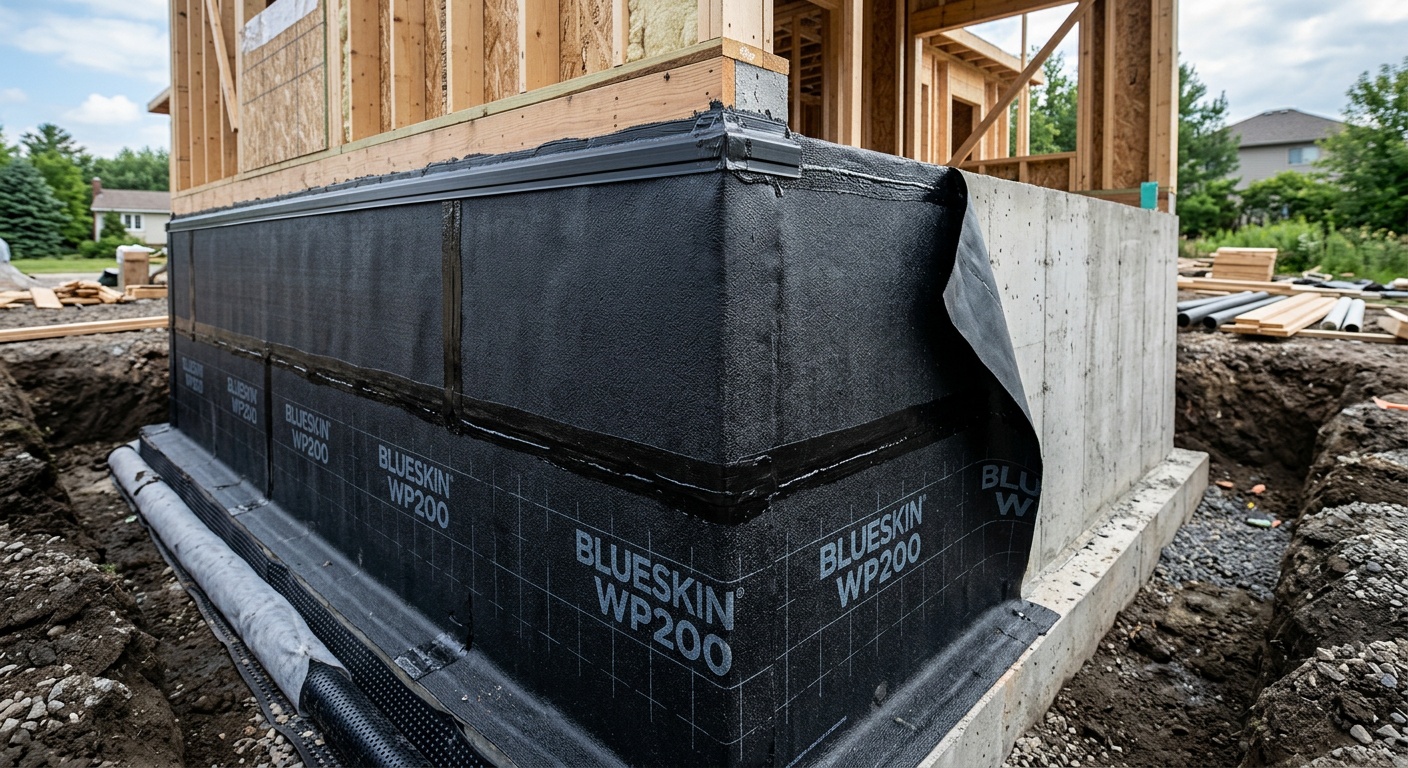
The workhorse of exterior waterproofing for decades, rubberized asphalt sheet membranes remain highly effective in 2026. These self-adhering sheets are applied directly to excavated foundation walls and form a continuous, flexible barrier against both bulk water and vapor. Their flexibility is critical — they accommodate minor foundation movement without cracking or delaminating.
Modern formulations have significantly improved over older products. Today’s rubberized asphalt membranes often incorporate drainage composites that channel any water that does reach the membrane face downward to footer drains, rather than allowing hydrostatic pressure to build. This drainage integration is what separates a high-performance installation from a basic one.
Best for: Existing homes undergoing full exterior excavation, particularly in climates with significant seasonal precipitation.
Spray-Applied Polyurethane and Polyurea Coatings
Spray-applied coatings represent the fastest-growing segment of the exterior waterproofing market, with industry adoption increasing by 27% between 2023 and 2025 according to the National Waterproofing Industry Association’s 2025 Annual Market Report. These systems cure rapidly, achieve high elongation values (accommodating substantial structural movement), and bond exceptionally well to prepared concrete surfaces.
Polyurea formulations in particular have gained favor for their ability to cure in cold or damp conditions — a practical advantage when excavation timelines are compressed. From an energy standpoint, a seamless spray-applied coating eliminates the lap joints and seams that are potential weak points in sheet membrane systems.
Best for: Complex foundation geometries, regions with extreme temperature variation, and projects requiring rapid installation.
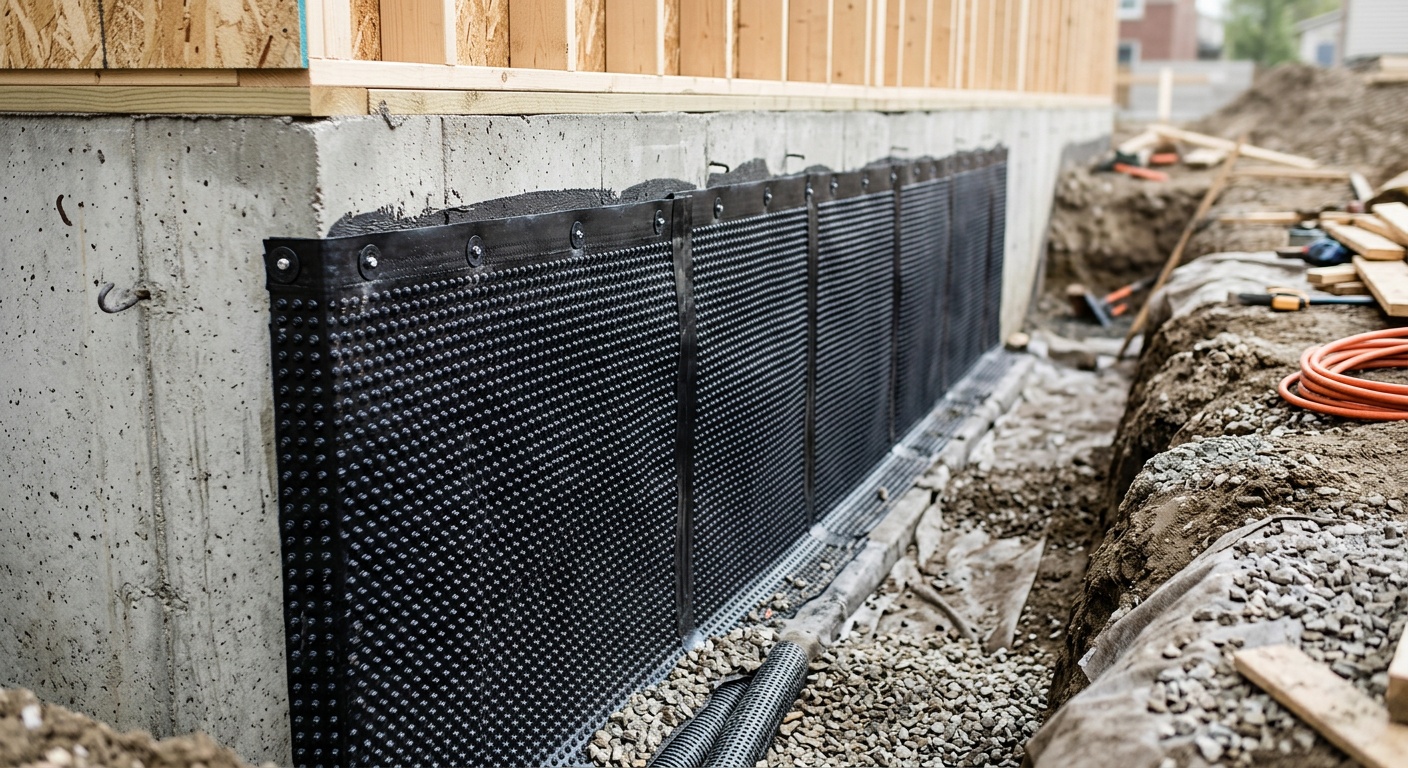
Dimple Mat Drainage Systems
Dimple mats — high-density polyethylene sheets with raised dimples that create an air gap between the waterproofing membrane and backfilled soil — are rarely used alone but are critical components of high-performance exterior systems. By creating a capillary break, they prevent soil moisture from maintaining continuous contact with your waterproofing layer. This air gap also provides a modest but meaningful improvement in the overall thermal resistance of the below-grade wall assembly.
When combined with a primary membrane and proper footer drainage, dimple mats contribute to drainage systems that actively channel water away from the foundation rather than simply resisting it — a fundamentally superior approach for long-term performance.
Exterior Insulation Integration: The Energy Performance Multiplier
Here’s where exterior waterproofing becomes a genuine energy performance strategy rather than just a moisture management exercise. When foundation walls are excavated for waterproofing work, you have a rare opportunity to install continuous exterior rigid insulation simultaneously — at dramatically lower incremental cost than doing it as a standalone project.
Extruded polystyrene (XPS) and expanded polystyrene (EPS) boards are the most common choices for below-grade application, rated for moisture resistance and ground contact. Installing R-10 to R-20 of exterior rigid insulation transforms a previously under-performing foundation wall into a meaningful part of your building’s thermal envelope. The 2025 International Energy Conservation Code updates now specifically reference this combination approach as a best practice for below-grade assemblies.
The Direct Energy Performance Impact: What the Data Shows
The connection between exterior basement waterproofing and energy savings is increasingly well-documented. Let’s look at the specific mechanisms and quantified impacts.
A comprehensive analysis published in the Journal of Building Physics in late 2024 tracked 47 residential retrofit projects across climate zones 4 through 6 (the Northern U.S. and Canada). Homes that received full exterior waterproofing with integrated insulation showed average annual heating and cooling savings of $340 to $780, depending on home size, climate, and existing insulation levels. The payback period, when considering avoided repair costs alongside energy savings, averaged 8.3 years.
Perhaps more compelling: homes with properly executed exterior waterproofing systems demonstrated an average 12% improvement in HERS (Home Energy Rating System) scores, meaningfully increasing home value and mortgage eligibility for energy-efficient financing programs.
Below is a visualization of average annual energy savings by waterproofing method type, based on combined 2024–2025 field study data:
Average Annual Energy Savings by Exterior Waterproofing Approach
Source: Combined field data, Journal of Building Physics 2024 & Building Science Corporation 2025
The message from this data is clear: exterior approaches consistently outperform interior-only solutions on energy metrics, and the combination of membrane waterproofing with exterior insulation delivers the strongest results by a significant margin.
Real-World Case Studies: Homes That Got It Right
Case Study 1: The Minneapolis Split-Level — Turning a Liability into an Asset
In the spring of 2024, a homeowner in suburban Minneapolis approached a building performance contractor with a recurring problem: annual basement seepage, rising humidity in the main living areas every summer, and heating bills that consistently ran 22% above neighbors with comparable homes. The 1962 split-level had never received any below-grade waterproofing beyond the original damp-proofing applied at construction — a bituminous coating that had long since degraded.
The solution was a comprehensive exterior excavation project covering all four foundation walls. The contractor applied a spray-applied polyurea membrane, installed a dimple mat drainage system, added R-15 XPS board insulation, and tied the footer drainage into an upgraded French drain system. Total project cost: $23,400.
By winter 2024–2025, the homeowner’s heating bills had dropped by 19%, and for the first time in years, the basement was being used as a finished living space — eliminating a planned HVAC expansion project. The estimated net benefit when combining energy savings, avoided structural repairs, and increased usable square footage came to approximately $4,100 annually, suggesting a payback under six years.
Case Study 2: Portland Bungalow — Passive House Journey Begins Below Grade
A Portland, Oregon couple pursuing a phased Passive House retrofit learned in 2025 that their below-grade thermal envelope was their biggest single obstacle. Energy modeling revealed that foundation heat loss accounted for 31% of their total envelope losses — more than windows and roof combined.
Their contractor recommended crystalline waterproofing (ideal for Portland’s moderate but persistent rain) combined with a full exterior insulation layer of R-20 EPS — chosen for its lower environmental impact versus XPS. The project was staged over two seasons to manage excavation costs, addressing the two long walls first, then the short walls the following year.
The result: their HERS score improved from 87 to 61 from the foundation work alone, qualifying them for a $4,200 federal energy-efficiency tax credit under the Inflation Reduction Act provisions that remained in effect through 2025. Their modeled path to Passive House certification is now achievable with significantly less investment in the mechanical systems — because the thermal envelope does more of the work.
Common Challenges and How to Overcome Them
Exterior waterproofing is genuinely more complex and disruptive than interior approaches. Understanding the common challenges — and having strategies to navigate them — is essential before committing to a project.
Challenge 1: Excavation Cost and Site Disruption
The biggest barrier to exterior waterproofing is the excavation required to expose foundation walls. Depending on foundation depth, landscaping complexity, and site access, excavation can represent 30–40% of total project cost. Decks, mature trees, utility lines, and hardscaped areas all complicate the process and add expense.
How to overcome it: Prioritize walls by severity. A qualified contractor can use moisture mapping and thermal imaging to identify which foundation walls are driving the most energy loss and moisture infiltration — and address those first if budget constraints require a phased approach. In some cases, treating just two high-priority walls delivers 70–80% of the total benefit at 50–60% of the cost.
Challenge 2: Contractor Quality Variation
The waterproofing industry has significant quality variation. Poorly applied membranes, inadequate surface preparation, or improper footer drainage integration can produce a system that fails within 5–10 years — far short of the 25+ year service life a properly executed installation should deliver.
How to overcome it: Require contractors to demonstrate specific product certifications (most membrane manufacturers offer contractor certification programs). Request documentation of completed similar projects and check warranty terms carefully — a manufacturer-backed warranty that requires certified installation is a meaningful quality indicator. In 2026, several leading manufacturers including Tremco, BASF, and Sika offer contractor certification portals you can verify independently online.
Challenge 3: Integrating New Waterproofing with Existing Drainage Infrastructure
Exterior waterproofing systems depend on functional footer drainage to work correctly. In many older homes, existing footer drains are either absent, crushed, or filled with sediment. Installing a high-performance membrane on walls without addressing footer drainage creates a system that intercepts water but has nowhere to channel it — eventually leading to hydrostatic pressure buildup that can compromise even excellent waterproofing materials.
How to overcome it: Always scope a footer drain inspection and replacement as part of any exterior waterproofing project. While this adds cost, it’s non-negotiable for long-term performance. Budget approximately $800–$2,200 per linear foot for new footer drain installation depending on depth and regional labor costs in 2026.
Method Comparison: Cost, Performance, and Energy Savings
| Method | Avg. Cost (per linear ft) | Energy Impact | Lifespan | Best Climate |
|---|---|---|---|---|
| Crystalline Membrane | $80–$130 | Moderate (vapor control) | Lifetime (self-sealing) | Humid, moderate rain |
| Rubberized Asphalt Sheet | $110–$180 | High (bulk water + vapor) | 20–30 years | High precipitation regions |
| Spray Polyurea Coating | $140–$220 | Very High (seamless barrier) | 25–35 years | All climates, complex geometry |
| Membrane + Exterior Insulation | $190–$310 | Maximum (moisture + thermal) | 25–40 years | Cold climates (zones 4–7) |
| Interior Drainage Only (control) | $50–$90 | Low (water management only) | 10–20 years | Limited moisture situations |
Note: Cost figures reflect 2026 U.S. national averages inclusive of excavation and backfill. Regional variation of ±25% is typical. Insulation costs are calculated separately from membrane costs.
Frequently Asked Questions
Does exterior waterproofing qualify for federal tax credits or energy efficiency incentives in 2026?
It depends on how the project is structured. Pure waterproofing membrane installation does not directly qualify for federal energy tax credits on its own. However, when exterior waterproofing is paired with qualified insulation installation that meets IRC prescriptive R-value requirements for below-grade assemblies, the insulation component qualifies for the 25C energy efficiency home improvement credit — which in 2026 covers 30% of insulation material costs up to a $1,200 annual cap. Additionally, some states — including Massachusetts, Minnesota, and New York — have utility rebate programs that recognize below-grade thermal envelope improvements as qualifying energy upgrades. Always consult a tax professional and check your utility’s rebate portal before project completion.
How do I know if my basement truly needs exterior waterproofing versus interior solutions?
The clearest indicators that exterior waterproofing is warranted include: visible efflorescence (white mineral deposits) on exterior-facing walls, water infiltration that occurs during or immediately following rain events (suggesting surface water penetration rather than rising groundwater), and thermal imaging that reveals consistent cold spots across broad wall areas rather than isolated points. Interior drainage solutions are appropriate when the primary issue is hydrostatic groundwater pressure through the floor or footer area — situations where excavation wouldn’t address the moisture source. A qualified building performance contractor with thermography capabilities can differentiate between these scenarios definitively, typically for an inspection fee of $200–$500.
How disruptive is the exterior waterproofing process and how long does a typical project take?
The honest answer is: it’s a significant undertaking. A full-perimeter exterior waterproofing project on a typical 1,500 square foot footprint home generally requires 5–10 business days of active work, plus dry-weather curing time before backfilling. You should anticipate excavation equipment in your yard, temporary displacement of landscaping, and potential disruption to driveways or walkways. If utility lines (gas, electric, water, sewer) run near the foundation, mark-out services must be completed before excavation begins — your contractor should arrange this, but verify it. The upside: a properly managed project leaves the foundation area in better drainage condition than before, and many homeowners use the opportunity to upgrade grade slopes and install new landscaping that complements the waterproofing system’s drainage design.
Your Waterproofing Action Plan: Protect the Foundation, Power the Future
You now have a clearer picture than most homeowners will ever have about what’s actually happening below grade — and what you can do about it. Here’s how to move from information to action with confidence:
- Start with a diagnostic, not a quote. Commission a thermal imaging scan and moisture assessment before contacting waterproofing contractors. Understanding your specific problem prevents you from buying solutions you don’t need and equips you to evaluate contractor recommendations critically.
- Prioritize your walls strategically. If budget requires a phased approach, use your diagnostic data to identify the highest-priority walls — typically those facing prevailing weather or showing the most thermal loss — and address those first.
- Bundle insulation with your membrane work. The incremental cost of adding exterior rigid insulation during an excavation project is modest compared to the standalone cost. This single decision can double the energy performance return of your waterproofing investment.
- Verify contractor credentials before signing. Confirm membrane manufacturer certification, check references from projects at least three years old (so you can assess long-term performance), and ensure your contract specifies footer drain inspection and replacement as needed.
- Document everything for tax and resale purposes. Retain all receipts, energy audit reports, and warranty documentation. Energy-efficient home improvements are increasingly valued by buyers in 2026’s market, and documentation of a comprehensive below-grade system is a genuine selling point.
The broader trend is unmistakable: as energy codes tighten, climate impacts intensify, and home energy costs continue their upward trajectory, below-grade performance is moving from afterthought to strategic priority. Homeowners who invest in comprehensive exterior waterproofing today are simultaneously solving a moisture problem, reducing energy costs, and future-proofing their homes against increasingly stringent building performance standards likely to take effect by 2028 and beyond.
Your basement is the foundation of everything above it — literally and thermally. The question worth sitting with is this: what is it costing you, in energy and peace of mind, to keep deferring this investment?
Article reviewed by Dr. Elena Vasquez, Architectural Permit Specialist & Building Code Consultant, on July 15, 2026