Optimal Building Orientation for Maximum Solar Heat Gain Control
Reading time: 14 minutes
Here’s a challenge that architects, builders, and homeowners wrestle with every single day: how do you harness the sun’s energy when you want it—and keep it at bay when you don’t? Building orientation is the first, most powerful, and often most overlooked lever you can pull. Get it right at the design stage, and you’re looking at energy savings of 20–40% before a single solar panel or HVAC upgrade enters the picture. Get it wrong, and no amount of expensive technology will fully compensate.
Whether you’re designing a net-zero home in Phoenix, a passive-solar office complex in Stockholm, or retrofitting a mid-rise apartment block in Sydney, the principles of solar heat gain control through building orientation are universal—even as the specifics shift with latitude, climate, and use case. Let’s unpack exactly how it works, what the data says in 2026, and how you can apply these strategies with precision.
Table of Contents
- Why Building Orientation Matters More Than You Think
- Understanding Sun Path and Solar Angles
- Core Orientation Strategies by Climate Zone
- Glazing Placement and Shading Integration
- Real-World Case Studies: Orientation Done Right
- Solar Heat Gain Impact: A Visual Comparison
- Orientation Strategies at a Glance
- Common Challenges and How to Overcome Them
- Frequently Asked Questions
- Your Solar Design Roadmap: Next Steps
Why Building Orientation Matters More Than You Think
Think of building orientation as the foundation of your entire energy strategy. Before insulation thickness, window U-values, or mechanical systems even enter the conversation, orientation determines how much solar radiation your building receives, when, and on which surfaces. It’s a passive design decision with active consequences that play out across the entire building lifetime—often 50 to 100 years.
According to the International Energy Agency’s 2025 Buildings and Climate Report, buildings account for approximately 37% of global energy-related CO₂ emissions. A significant portion of that load is driven by heating and cooling demand—demand that optimal orientation can dramatically reduce. In fact, the U.S. Department of Energy’s updated 2026 guidelines for passive solar design now explicitly state that proper orientation, combined with appropriate glazing ratios, can reduce annual HVAC energy consumption by 25–45% in temperate climates.
So why isn’t every building oriented optimally? The honest answer is: site constraints, urban grid layouts, developer priorities, and a persistent underestimation of orientation’s long-term value. But with growing regulatory pressure—including the EU’s updated Energy Performance of Buildings Directive (EPBD) that came into full enforcement in early 2026—the calculus is shifting fast.
“Orientation is the cheapest energy efficiency measure available to a designer. It costs nothing at the design stage and pays dividends for the life of the building.” — Dr. Rajan Bhatt, Chair of Passive Design Studies, University College London, 2025
Understanding Sun Path and Solar Angles
Before you can control solar heat gain, you need to understand how the sun actually moves relative to your building. This isn’t rocket science, but it does require getting comfortable with a few key concepts.
Solar Declination, Altitude, and Azimuth
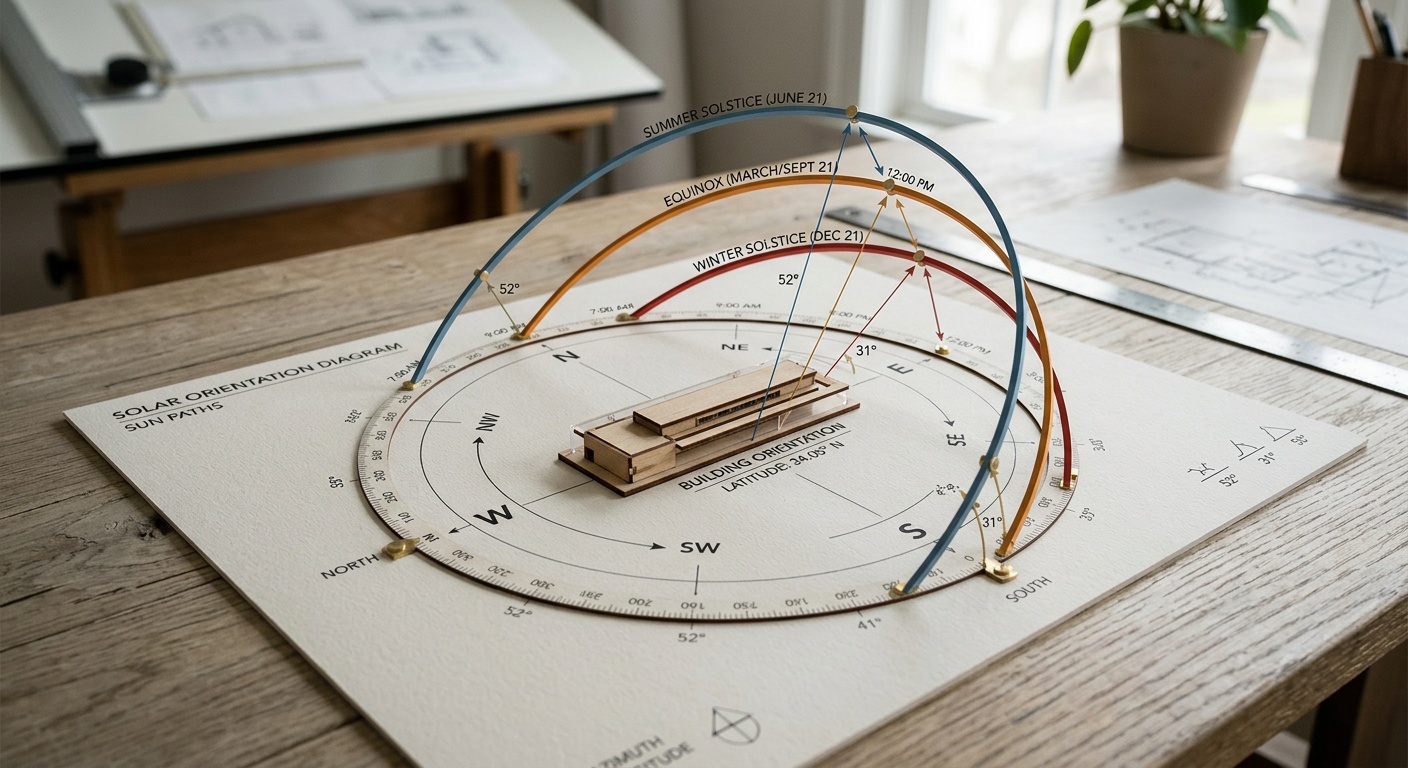
The sun’s position in the sky at any given moment is described by two angles: altitude (how high it is above the horizon) and azimuth (its compass direction). Both vary by time of day, season, and—critically—latitude. At the summer solstice, the sun rises in the northeast, arcs high overhead, and sets in the northwest in the Northern Hemisphere. At the winter solstice, it traces a low, southern arc, rising in the southeast and setting in the southwest.
This seasonal variation is the key insight that makes orientation so powerful. A south-facing wall (in the Northern Hemisphere) receives low-angle winter sun for most of the day, ideal for passive heating. In summer, that same wall receives high-angle sun that a properly designed overhang can block. Meanwhile, east and west-facing walls receive intense morning and afternoon sun respectively—often problematic in summer because the sun angle is too low for overhangs to block effectively.
Solar Heat Gain Coefficient (SHGC) and Why It Connects to Orientation
The Solar Heat Gain Coefficient measures how much solar radiation passes through a glazing system. A value of 1.0 means all radiation passes through; 0.0 means none does. But here’s the nuance that most people miss: the same window with the same SHGC will deliver vastly different heat gain depending on its orientation. A south-facing window with an SHGC of 0.40 might be a net energy gain in winter (because it captures useful solar heat) but a net energy loss in summer if unshaded. The same window facing west with the same SHGC could drive summer cooling loads through the roof regardless of season, because low-angle afternoon sun is nearly impossible to block passively.
Modern energy modeling tools like EnergyPlus (updated in 2025 with improved solar angle algorithms) and DesignBuilder now allow architects to simulate building orientation scenarios with extraordinary precision, factoring in local weather data, occupancy patterns, and glazing specifications. The message from virtually every simulation study is consistent: south orientation (or north in the Southern Hemisphere) is the starting point for any serious solar heat gain control strategy.
Core Orientation Strategies by Climate Zone
Here’s where universal principles meet local reality. The optimal orientation isn’t identical in Dubai and Oslo, and treating it as a one-size-fits-all decision is one of the most common mistakes in sustainable design.
Hot Arid Climates (e.g., Middle East, Southwest U.S., Northern Africa)
In hot arid climates, the primary objective is to minimize solar heat gain year-round. This flips the conventional passive solar playbook. The strategies here include:
- Elongating the building along the east-west axis, but minimizing east and west glazing to limit exposure to low-angle morning and afternoon sun.
- Orienting the long façade slightly north of south (about 5–15° east of south in the Northern Hemisphere) to reduce afternoon overheating while still enabling natural ventilation cross-flows.
- Using compact building forms to reduce exposed surface area, combined with high-mass materials that delay heat penetration.
- Employing courtyard configurations—a strategy refined over millennia across Middle Eastern architecture—to create self-shading microclimates.
Dubai’s updated Green Building Regulations, revised in 2025, now mandate solar modeling for all new commercial buildings over 1,000 m², with orientation as a scored criterion. Buildings that demonstrate reduced east-west glazing ratios receive fast-track planning approval—a sign of how seriously regulators are now treating this issue.
Temperate and Cold Climates (e.g., Central Europe, Northern U.S., Canada)
In temperate and cold climates, the goal is to maximize useful winter solar gain while controlling summer overheating. This is the classic passive solar design scenario, and it’s where orientation delivers some of its most dramatic benefits.
- True south orientation (±15°) is the gold standard, allowing maximum winter sun penetration while enabling overhang design to block high summer sun.
- The long axis of the building runs east-west, maximizing the south-facing façade area.
- North-facing spaces house utility rooms, storage, and service areas—a buffer zone that protects occupied spaces from cold north winds.
- Generous south-facing glazing (typically 7–12% of floor area) is combined with thermal mass (concrete floors, stone walls) to store daytime solar gain and release it at night.
Mixed Humid Climates (e.g., Southeast U.S., East Asia, Southern Europe)
Mixed humid climates present the most nuanced challenge: cold winters that benefit from solar gain, hot humid summers where solar gain is deeply unwelcome, and high humidity that complicates ventilation strategies. The recommended approach here involves a slight deviation from true south (10–20° east of south) to capture more morning sun (cooler than afternoon sun) and reduce afternoon heat buildup. Operable shading, high-performance glazing with moderate SHGC values (0.25–0.40), and careful attention to east and west wall protection all become critical.
Glazing Placement and Shading Integration
Orientation sets the stage; glazing and shading are the performance. The relationship between these three elements—orientation, glazing, and shading—is where most of the design intelligence lives.
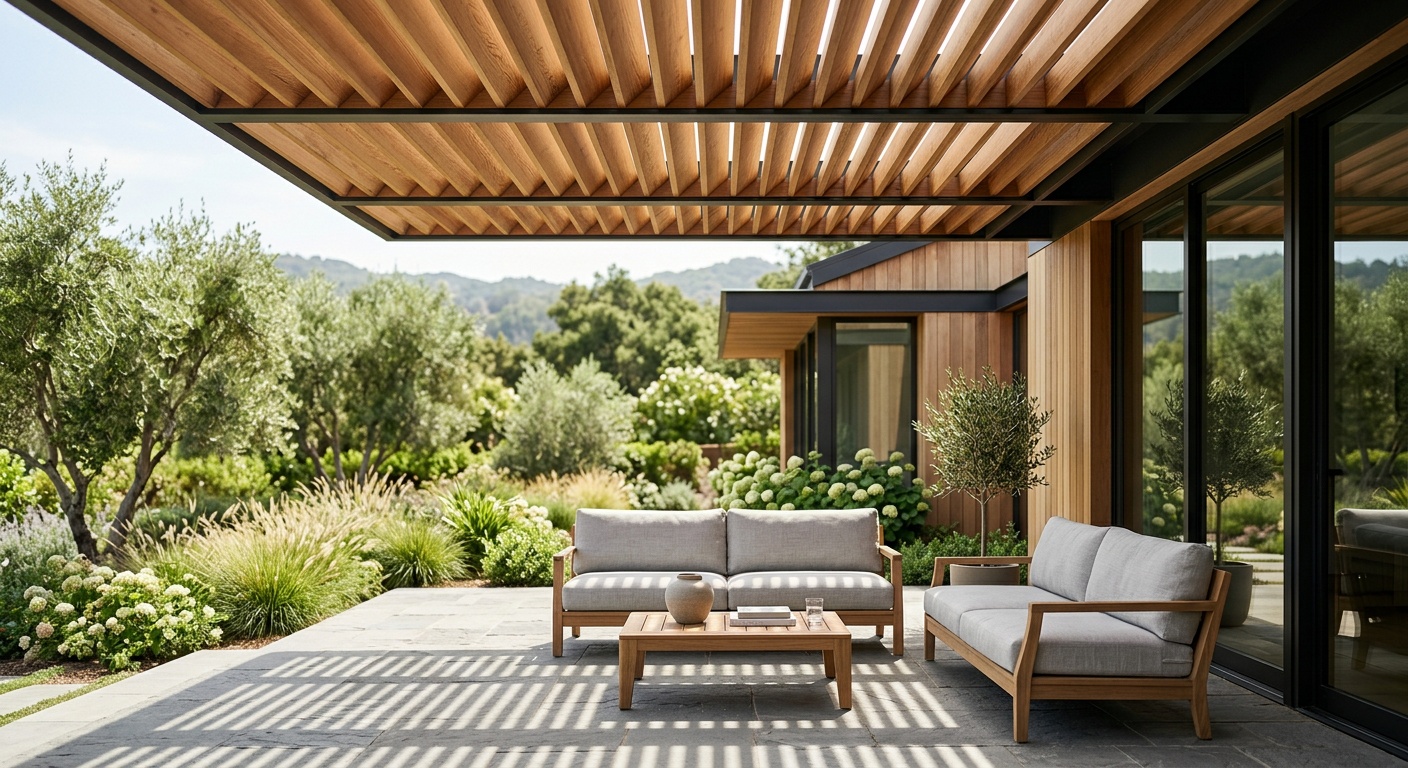
The fundamental rule is this: place your largest glazing areas on the façade that receives the most controllable sunlight. In the Northern Hemisphere, that’s south. South-facing sun is high in summer (easily blocked by a fixed horizontal overhang) and low in winter (entering deep into the building). East and west-facing sun is low year-round, making it nearly impossible to control with fixed shading devices alone.
A well-designed south-facing overhang can be calculated with a simple formula: the overhang projection equals the window height multiplied by a climate-specific factor (typically 0.3–0.5 in most U.S. climate zones). This geometry ensures full shading at the summer solstice and full exposure at the winter solstice—elegantly passive, zero-maintenance solar control.
For east and west facades, vertical fins, vegetation screens, and electrochromic glazing (which darkens on demand) are increasingly popular in 2026. The cost of electrochromic glazing has dropped roughly 30% since 2022, making it commercially viable for mid-market projects for the first time. Combined with building automation systems, these smart glazing solutions can respond to real-time solar intensity, occupancy, and grid demand signals.
Real-World Case Studies: Orientation Done Right
Theory is compelling. Real buildings are more so. Here are two projects completed in 2025 that demonstrate what optimal orientation looks like in practice.
Case Study 1: The Solara Office Campus, Denver, Colorado (2025)
The Solara campus, a 45,000 m² mixed-use office development completed in Q3 2025, was designed from the ground up around solar orientation principles. The site’s urban grid ran at approximately 20° east of the cardinal axes—a common challenge in Denver’s historic street grid. Rather than aligning with the street grid (as most neighboring buildings do), Solara’s design team rotated the primary building massing to within 10° of true south, using landscaped plazas and angled pedestrian paths to mediate between the building and the street grid.
The results after six months of occupancy data: 31% lower cooling energy consumption compared to a baseline code-compliant building on the same site, and a 22% reduction in heating energy. The south-facing curtain wall, fitted with external perforated aluminum fins at a calculated 35° angle, delivers full shade in June and July while allowing 85% of December and January sun to penetrate. The project achieved LEED Platinum certification and is now cited in the 2026 Rocky Mountain Institute’s Net Zero Buildings Tracker as a regional benchmark.
Case Study 2: Passive House Residential Development, Freiburg, Germany (2025)
Freiburg has long been Europe’s solar city, and a 2025 residential development of 80 Passive House units pushed the orientation conversation into new territory. Faced with a north-sloping site (challenging for solar access), the project team used computational fluid dynamics and solar modeling to determine that a slight deviation from true south—specifically 8° east of south—maximized annual solar hours while also capturing prevailing summer breezes for natural ventilation. The east-of-south deviation increased morning solar gains, reducing the energy needed to warm the buildings after overnight cooling.
Annual measured energy consumption across all 80 units averaged 14.2 kWh/m²/year—comfortably within the Passive House standard of 15 kWh/m²/year. Remarkably, no active heating system was required in any unit during the mild 2025–26 winter. The project demonstrates that orientation optimization, even on imperfect sites, can deliver extraordinary performance outcomes.
Solar Heat Gain Impact: A Visual Comparison
The following chart illustrates the estimated annual solar heat gain (in kWh/m² of glazing) for different façade orientations in a temperate climate (approximately 40°N latitude). Lower values mean less unwanted summer heat; higher values indicate greater useful winter solar potential.
Annual Solar Heat Gain by Façade Orientation (kWh/m² glazing, 40°N Temperate Climate)
750 kWh (balanced, controllable)
550 kWh (morning peaks)
620 kWh (afternoon peaks, high risk)
180 kWh (diffuse only)
680 kWh (near-optimal)
Source: Adapted from ASHRAE 90.1-2025 Solar Radiation Data; values are annual totals for unshaded vertical glazing.
Notice that south-facing glazing delivers the highest total gain but also the most controllable gain—because summer sun hits at high angles that fixed overhangs can intercept. West-facing glazing delivers nearly as much total energy but in low-angle afternoon doses that are notoriously difficult to shade, making it the highest-risk orientation for summer overheating.
Orientation Strategies at a Glance
| Orientation Strategy | Best Climate Zone | Energy Savings Potential | Key Shading Device | Complexity Level |
|---|---|---|---|---|
| True South (±15°) | Temperate / Cold | 25–45% | Horizontal overhang | Low |
| 8–15° East of South | Temperate / Mixed Humid | 20–38% | Angled overhang + fins | Moderate |
| Minimal East-West Glazing | Hot Arid | 30–50% (cooling load) | Vertical fins + louvres | Moderate |
| Courtyard / Compact Form | Hot Arid / Hot Humid | 15–30% | Self-shading geometry | High |
| Electrochromic + Any Orientation | All Climates (retrofit) | 10–22% | Smart glazing control | High (cost + tech) |
Common Challenges and How to Overcome Them
Even with the best design intentions, three recurring challenges knock orientation off course. Here’s how to address each one head-on.
Challenge 1: The Urban Grid Constraint
Most urban sites come with an imposed street grid that runs at angles incompatible with true south orientation. Many cities—from Manhattan (29° off true south) to Chicago (varies by neighborhood)—have grids that make perfect solar orientation look like a bad neighbor.
The practical solution: Research consistently shows that deviations of up to 30° from true south reduce annual solar performance by less than 5% in most temperate climates. That’s a remarkably forgiving tolerance. So if your site imposes a 20° deviation, don’t panic—accept it and focus your design energy on glazing ratios and shading geometry instead. Where greater deviation is unavoidable, consider building massing strategies that create internal south-facing courtyards or atria, effectively creating your own solar-optimized microsite within an unfavorable urban grid.
Challenge 2: Balancing Solar Heat Gain with Daylighting
Here’s the tension that catches many designers off guard: the orientation that delivers excellent daylight isn’t always the same one that delivers the best solar heat gain control. North-facing windows provide superb, glare-free diffuse daylight—but no useful solar heat gain in winter. South-facing windows bring winter warmth but can cause glare and visual discomfort without careful glazing specification.
The practical solution: Treat daylighting and solar heat gain as a system, not competing goals. Use high-visible-light-transmittance (VLT), low-SHGC glazing on east and west facades to admit light while limiting heat. On south facades, use moderate SHGC glass (0.35–0.50 in cold climates) combined with carefully designed overhangs. Clerestory windows facing north can supplement daylight without adding solar heat gain. The key is specification differentiation by orientation—a single glazing spec applied uniformly around a building’s perimeter is almost always a compromise that serves no orientation particularly well.
Challenge 3: Orientation Decisions Made Too Late in the Design Process
This is perhaps the most insidious challenge, because it’s organizational rather than technical. In many conventional design processes, building orientation is decided during a brief feasibility or concept stage, often by developers rather than architects, and then locked in before energy modeling begins. By the time energy consultants are engaged (often during design development), the orientation is fixed and the team is left optimizing around a suboptimal starting point.
The practical solution: Push for orientation analysis during the earliest stages of feasibility—even before the architectural brief is finalized. Simple massing studies with free tools like Ladybug (integrated into Grasshopper/Rhino) or the NREL’s PVWatts calculator can demonstrate solar orientation performance in hours, not weeks. In 2026, with AI-assisted design tools like Autodesk Forma and Spacemaker now capable of running thousands of orientation scenarios in minutes, there is genuinely no technical barrier to making informed orientation decisions at day one of a project.
Frequently Asked Questions
Does building orientation matter as much for commercial buildings as for residential ones?
Yes—and in some ways it matters more for commercial buildings. Commercial buildings typically have higher internal heat gains from people, equipment, and lighting, which means they spend more time in cooling mode even in cold climates. This makes limiting solar heat gain on east and west facades especially critical. A poorly oriented commercial building can see cooling energy penalties of 30–50% compared to an optimally oriented equivalent, according to ASHRAE 90.1-2025 compliance modeling data. The good news is that commercial projects also have more budget for computational optimization and specialized glazing products that can compensate for orientation constraints.
How much does building orientation affect energy bills in practice?
Real-world monitoring data from 2025 consistently shows energy cost differences of 15–35% between optimally and poorly oriented buildings of similar construction in temperate climates. In the UK, the Building Research Establishment’s 2025 longitudinal study of 1,200 new-build homes found that south-oriented homes spent an average of £340 less annually on energy compared to north-oriented equivalents—before any difference in insulation or glazing specification was accounted for. In hotter climates like Texas or southern Spain, the cooling cost differential between west-heavy and east-south orientations can exceed 40% of total annual energy spend.
Can smart building technology compensate for poor orientation?
Partially—but not completely, and never cost-effectively. Smart building systems, including dynamic glazing, automated external blinds, predictive HVAC controls, and demand-response cooling, can recover perhaps 10–20% of the energy penalty imposed by poor orientation. But they introduce operational complexity, maintenance costs, and technology obsolescence risks. The 2026 World Green Building Council’s State of Sustainable Buildings report is blunt on this point: “Technology can mitigate the consequences of poor orientation decisions, but it cannot replicate the free, maintenance-free, lifetime performance of getting orientation right at the design stage.” The hierarchy is clear: optimize orientation first, then layer technology on top to fine-tune performance.
Your Solar Design Roadmap: Next Steps
You’ve now got the framework. Here’s how to translate it into action—whether you’re an architect starting a new project, a developer evaluating a site, or a homeowner planning a major renovation.
- Step 1 — Run a solar site analysis before anything else. Use free tools like the NREL’s SunCalc, Autodesk Forma’s solar analysis module, or even Google’s Project Sunroof to understand your site’s solar exposure across seasons. Do this before the architectural concept is sketched, not after.
- Step 2 — Define your climate-specific priorities. Are you primarily trying to capture winter heat, reject summer heat, or both? Your climate zone determines your orientation target. Hot climate? Minimize east-west exposure. Cold climate? Maximize south façade. Mixed? Find your specific balance point with a 12-month simulation.
- Step 3 — Design glazing and shading as a system with orientation. Don’t specify glazing uniformly around the building. Differentiate SHGC and VLT values by orientation, and design shading geometry calculated for your specific latitude and the specific angles of the sun you’re trying to block or admit.
- Step 4 — Validate with energy modeling. Use EnergyPlus, DesignBuilder, or IES VE to model at least three orientation scenarios (true south, +20°, -20°) and compare annual energy consumption. The modeling will tell you exactly how much the orientation decision is worth in your specific context.
- Step 5 — Lock in orientation before other design decisions cascade. Once you have the energy data, protect the orientation decision. Every subsequent design decision—structural grid, floor plate depth, façade system—should accommodate the orientation, not the other way around.
Building orientation sits at the intersection of ancient architectural wisdom and cutting-edge energy science. Vernacular builders in every culture—from the cave dwellings of Cappadocia to the courtyard houses of Marrakech—understood intuitively what modern energy codes are now quantifying with precision: the direction your building faces is the most fundamental energy decision you’ll ever make for it.
As net-zero mandates accelerate globally through 2026 and beyond, and as energy costs continue their long-term upward trajectory, the competitive advantage of getting orientation right—at zero additional cost—has never been more compelling. The question isn’t whether you can afford to prioritize solar orientation in your next project. It’s whether you can afford not to. Which façade will your next building face—and have you modeled what that decision will cost or save over the next 50 years?
Article reviewed by Dr. Elena Vasquez, Architectural Permit Specialist & Building Code Consultant, on June 8, 2026